
The Shift: A Symbolic Forecast for the AI/NHI Era
As the world speeds up, pressure rises—and the truth, whatever it is, may arrive in fragments before it arrives in full. A symbolic reading on AI, NHI, and the path through the shift.

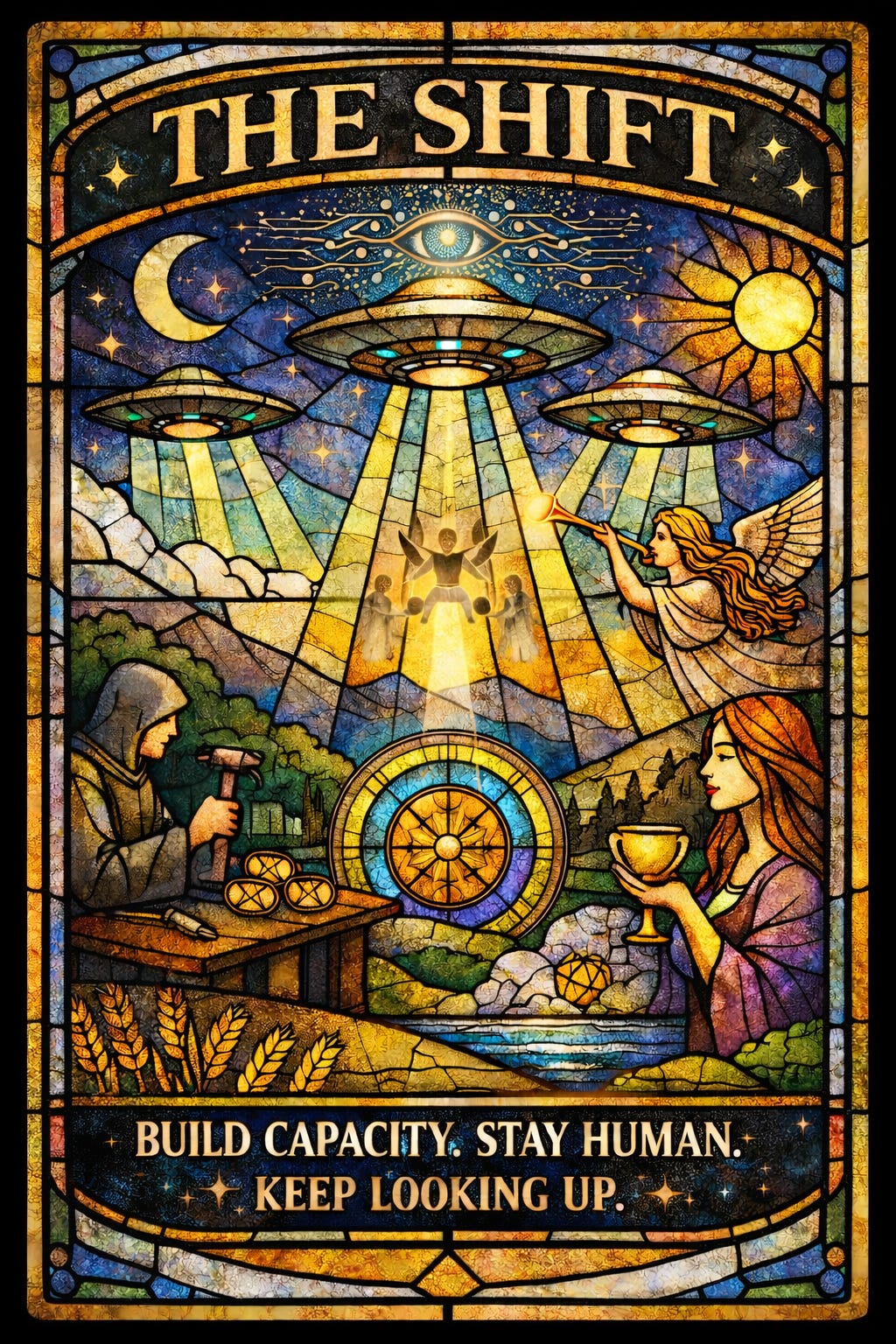
THE SHIFT
Esotechnological Tarot™ (Augmented Intuition™): a symbolic “forecast” on AI, NHI, and the pace of change
(Card art attached — “THE SHIFT: Build Capacity. Stay Human. Keep Looking Up.” AI-generated image for thematic illustration.)
We’re entering a season where reality feels faster than our nervous systems. The cards framed it as a threshold: speed, strain, and a truth that arrives in fragments before it arrives in full.
Why I’m sharing this
A lot of the conversations happening right now — about AI, disclosure, NHI/UAP, consciousness/psi, and “what the hell is happening to reality” — live right at the edge of certainty. People want a way to talk about it that isn’t blind belief or reflexive dismissal.
This is one way I’ve been experimenting: a symbolic tool that can hold uncertainty, spot patterns, and give a “shape” to what feels likely, without pretending it’s verified fact.
Context & Disclaimer
This post uses an informal method I’ve been experimenting with that blends intuition and technology. I’ve been calling it Esotechnological Tarot™, with Augmented Intuition™ as a secondary label coined by the AI.
Basic idea: a human draws tarot cards using intuition, and an AI helps interpret the symbols by identifying themes and narrative structure in clear, grounded language. The intuition remains human; the technology supports reflection and synthesis.
AI note: the AI helped translate the card symbolism into coherent themes and wording, but the interpretation was guided and checked against my own intuition. I also asked for help from benevolent sources; this may reflect that — while acknowledging interpretation can be imperfect.
This is shared for discussion, reflection, and curiosity. It makes no claim of proof, certainty, or authority. Treat it like a symbolic forecast: not facts, but a map of what kinds of developments feel more likely than others given the pattern of cards.
TL;DR (Symbolic Forecast)
Near-term: rapid jumps + headline catalysts (Knight of Wands, Eight of Wands) + rising overload (Ten of Wands)
NHI tone: distance/ambiguity, indirect traces (Five of Pentacles), “ancient/steady” presence (King of Pentacles)
Pivot: a collective ethical/psychological threshold (Judgment)
What works: slow capacity-building (Knight of Pentacles, Eight of Pentacles)
Long arc: emotional integration in cycles (Queen of Cups, The Wheel of Fortune)
Bottom line: Build capacity. Stay human. Keep looking up.
Cards drawn (in order)
King of Pentacles, Ten of Wands, Five of Pentacles, Knight of Pentacles, Judgment, Knight of Wands, Queen of Cups, The Wheel of Fortune, Eight of Pentacles, Eight of Wands
High-level theme
If I had to compress the entire reading into one sentence, it’s this:
The pace increases, the pressure rises, and whatever “truth” emerges arrives more through accumulation than spectacle — so the best response is to build capacity, stay human, and keep looking up.
That’s the emotional spine of it. The rest is how each card supports that arc.
1) Near-term: speed + strain
Two things show up immediately, side by side:
Acceleration / catalysts (Knight of Wands, Eight of Wands): rapid leaps, sudden “turns,” headline moments, fast-moving narratives.
Overload (Ten of Wands): people and institutions struggling to keep up, regulate, or integrate what’s happening.
In practical terms: more churn, more debate, more “too much too fast.” Not just technologically — socially, psychologically, culturally. We’re trying to metabolize a faster world with nervous systems designed for a slower one.
2) The “NHI / advanced intelligence” tone: distant, ambiguous, ancient
The pattern leans away from “they show up openly” and more toward distance and ambiguity:
Five of Pentacles carries the feeling of the “great silence”: the sense of being outside the lit window, aware there’s something there but unable to access it cleanly. It reads less like overt hostility and more like indirectness, partial visibility, or missed contact points. If something emerges, it’s more likely through traces: signals, leaks, partial disclosures, anomalous data, “something is there but not clear.”
King of Pentacles adds a particular flavor: steady, grounded, long-established. This is where the “ancient” tone comes in — not “resource secure,” but enduring. If there is an advanced intelligence in the mix, the vibe is not frantic, not reactive, not chaotic. It feels stable, with a long horizon.
Taken together: if “they” exist, the reading leans toward non-violent in the sense of not acting like an aggressor, but also non-interventionist — present at a distance, not rushing to rescue or engage on human timelines.
A simple summary of this section:
Not a Hollywood landing. More like a shadow at the edge of the frame that keeps showing up.
3) The pivot point: Judgment as a threshold
Judgment is the structural hinge of the reading.
It frames readiness not as “we hit a tech milestone,” but as a psychological and ethical reckoning. A moment where the dominant argument stops being “is it real?” and becomes:
What counts as intelligence?
Who gets authority over the narrative?
What responsibilities come with powerful tools?
What do we do when old assumptions crack?
Judgment doesn’t have to mean fear. It can mean clarity, accountability, and a collective wake-up. But it does imply a “before and after” — a threshold.
4) What moves things forward: slow capacity-building (not hype)
This is where the reading becomes very practical:
Knight of Pentacles + Eight of Pentacles say the strongest predictor isn’t hype — it’s capacity.
Research. Infrastructure. Standards. Skills. Training. Emotional regulation. Systems that hold pressure without snapping.
There’s almost a “boring on purpose” message here: the real work is methodical — and that’s what makes it durable.
Even if big moments happen (Wands), what sticks is what gets built (Pentacles).
5) Longer arc: empathy and integration, in cycles
The end of the reading isn’t “apocalypse” or “utopia.” It’s integration:
Queen of Cups points toward increasing emotional intelligence — more empathy, more maturity, less fear-based reaction to the unknown. Not perfection. But a trend toward deeper regulation and relational capacity.
The Wheel of Fortune adds the cadence: this doesn’t unfold in a straight line. It comes in waves:
disruption → adaptation → disruption → adaptation
So the longer arc is hopeful, but not simplistic. It’s the kind of hope that includes cycles, setbacks, and recovery.
Closing
If you read this as a symbolic forecast, it points to a world where the pace keeps increasing, the pressure keeps rising, and the truth — whatever it is — arrives more through accumulation than spectacle.
The invitation here isn’t to panic or to worship mystery. It’s to become steady enough to meet it.
Build capacity. Stay human. Keep looking up.